Multimedia Resource: IBM – What Is Cloud Computing?
Introduction
For this assignment, I chose cloud computing as my threshold concept because it is something that I use almost every day, but I did not fully understand how it works. For example, I use Google Drive to save files and online applications to complete my schoolwork. Before learning about cloud computing, I mainly thought of the cloud as a place where people store their photos and documents (Mell & Grance, 2011).
I selected IBM’s video, What Is Cloud Computing?, because I wanted to understand the basic idea of cloud computing and how it is different from using a personal computer.
Description of the Multimedia Resource
The video introduces cloud computing and explains how people can access computing services through the Internet. These services include storage, servers, and software (IBM Developer, 2020).
One important idea is that the cloud still depends on physical servers. These servers are located in data centres and provide resources that people can use remotely (Mell & Grance, 2011). This helped me understand that cloud computing is not just an invisible space where files are saved.
I also think video is a useful format for this topic because cloud computing can be difficult to explain through written definitions alone.
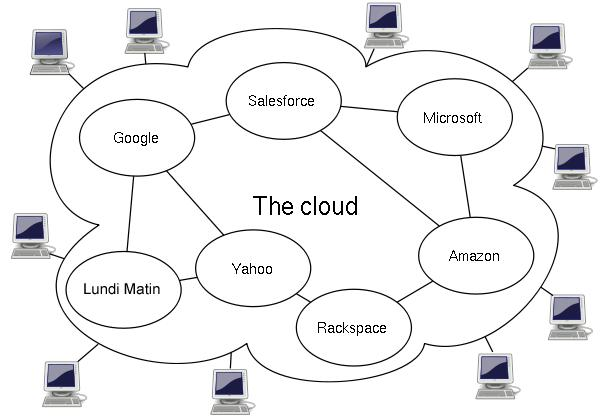
Figure 1. Overview of cloud computing. Source: Sam Johnston, Wikimedia Commons, CC BY-SA 3.0. https://commons.wikimedia.org/wiki/File:Cloud_computing.png?utm_source

Mayer’s Multimedia Learning Principles
The first principle I considered is the Multimedia Principle. Mayer explains that people can learn better when words and relevant pictures are presented together instead of words alone (Mayer, 2009). This is important for cloud computing because it can be difficult to imagine how servers and online services work.
The second principle is the Modality Principle. Combining spoken explanations with useful visuals can make information easier to understand than showing complicated diagrams with too much written text (Mayer, 2009).
However, using video does not automatically make learning easier. The visuals should support the explanation and avoid distracting learners.
My Learning Experience
This resource helped me connect cloud computing to my everyday life. I now understand that when I save an assignment to Google Drive, the file can be stored on remote servers instead of only on my laptop. This also explains why I can access the same file from different devices.
I also learned that cloud computing involves more than online storage. It can provide software and other computing resources through the Internet.
One thing I still find confusing is the difference between IaaS, PaaS, and SaaS. I think a simple comparison using familiar applications would help me understand these services better.

Figure 2. Comparison of IaaS, PaaS, and SaaS cloud service models. Image credit: HubSpot. Related article: https://blog.hubspot.com/service/iaas-paas-saas?utm_source
Overall Evaluation
Overall, I think IBM’s video is a useful introduction to cloud computing, especially for students who have little technical knowledge. The video format makes the topic more approachable than reading a long technical explanation.
I would recommend this resource to beginners, especially students who use cloud services but do not know much about the technology behind them. I think adding a simple diagram or a practical example, such as Google Drive, could make the learning experience even better.
This resource helped me connect cloud computing to my daily life and think about how multimedia can support learning.
References
IBM Developer. (2020, April 30). What is cloud computing? [Video]. YouTube. https://www.youtube.com/watch?v=Y-Jhlwy2sW4
Mayer, R. E. (2009). Multimedia learning (2nd ed.). Cambridge University Press. https://doi.org/10.1017/CBO9780511811678
Mell, P., & Grance, T. (2011). The NIST definition of cloud computing (NIST Special Publication 800-145). National Institute of Standards and Technology. https://doi.org/10.6028/NIST.SP.800-145
Susnjara, S., & Smalley, I. (n.d.). What is cloud computing? IBM. https://www.ibm.com/think/topics/cloud-computing