Introduction
Cloud computing is used in many online services, but some of its important features can be difficult to understand. In my previous reviews, I explored cloud computing, service models, security, and data centers. For my fifth review, I wanted to focus on how cloud systems manage resources and support different users.
I selected an educational YouTube video from the channel Teknikally Speaking. The video introduces important cloud computing concepts, including scalability, elasticity, multitenancy, deployment models, and service models. I chose this resource because these concepts help explain why cloud computing is useful for businesses and everyday technology users.
Multimedia Resource: Cloud Computing Video – Teknikally Speaking
Description of the Multimedia Resource
The video introduces several important characteristics of cloud computing. Three concepts that interested me were scalability, elasticity, and multitenancy.
Scalability refers to a system’s ability to handle an increasing amount of work by adding resources. For example, an online shopping website may need more computing power when many customers visit at the same time.
Elasticity is related to scalability, but it focuses on adjusting resources when demand changes. A business might need additional resources during a busy period and fewer resources when traffic becomes lower. This helps explain how cloud computing can support changing workloads.
Another concept is multitenancy, which means different customers can use shared cloud infrastructure while their information remains logically separated. This is important because cloud providers can serve many users without giving every customer completely separate physical equipment.
The video also covers public, private, and hybrid cloud deployment models, along with SaaS, PaaS, and IaaS. These topics connect to what I learned in Review 2.
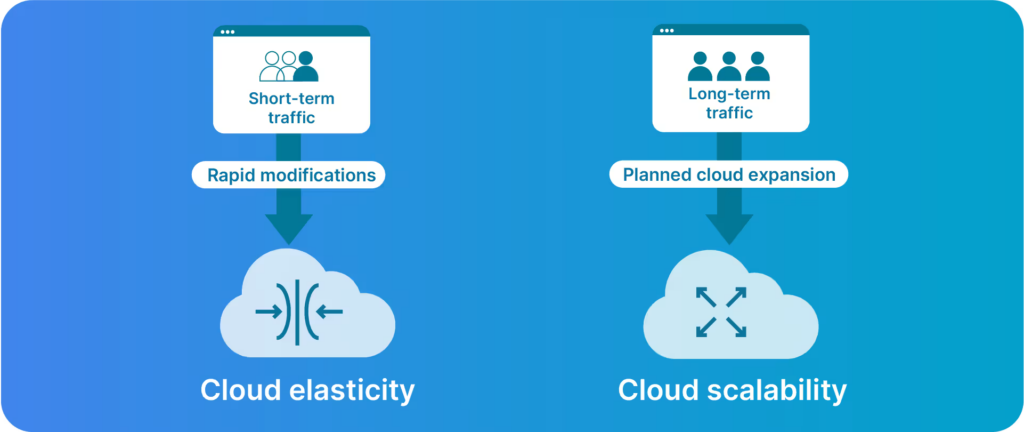
Figure 1. Comparison of cloud elasticity and cloud scalability. Elasticity responds to short-term traffic changes, while scalability supports long-term growth https://author.ashleybogner.com/elasticity-vs-scalability-scaleability-vs-elasticity/.
Connection to Mayer’s Multimedia Learning Principles
One principle I considered while reviewing this video was the Multimedia Principle. Mayer (2009) explains that learners generally understand information better when words and relevant pictures are presented together. For a topic such as cloud computing, visual explanations can help students understand technical concepts that are difficult to imagine.
Another relevant principle is the Segmenting Principle. Mayer (2009) suggests that complex information can be easier to learn when it is divided into smaller sections. Since this video covers several topics, I think it is useful for students to pause after each concept and review what they have learned before continuing.
The Signaling Principle is also important. This principle suggests that learners benefit when key information is clearly highlighted (Mayer, 2009). For example, showing the terms scalability and elasticity next to a simple comparison would help beginners understand the difference between them.
I think the video could be even more helpful if it included a short summary or comparison chart at the end. This would make it easier for learners to remember the most important differences.
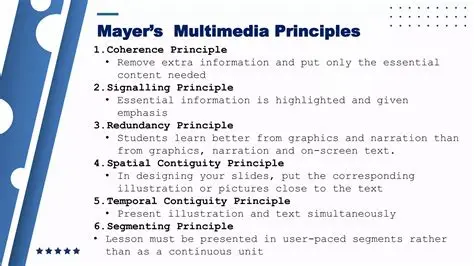
Figure 2. Overview of six multimedia learning principles, including coherence, signaling, redundancy, spatial contiguity, temporal contiguity, and segmenting https://www.slideshare.net/slideshow/multimedia-for-learningpptx/258631988.
My Learning Experience
The most interesting part of this topic for me was understanding the difference between scalability and elasticity. Before studying cloud computing, I did not realize that increasing resources and adjusting resources based on demand were related but different ideas.
Thinking about an online store helped me understand these concepts. When a store becomes popular, it needs enough computing resources to support more customers. However, keeping those extra resources all the time may not be necessary. Elasticity helps explain why adjusting resources to match demand is useful.
I also found multitenancy interesting because it changed how I thought about shared cloud services. I used to imagine that each business needed its own servers. Learning about multitenancy helped me understand how different customers can share infrastructure while maintaining separation between their information.
One challenge is that the video introduces several technical terms. I think beginners may need to pause and review some sections, especially when comparing service models and deployment models.
Overall Evaluation
Overall, I think this video is a useful resource for students learning about cloud computing. Its main strength is bringing several important cloud concepts together in one lesson. It can help students understand how cloud systems support different workloads, customers, and business needs.
The resource can be evaluated using Mayer’s Multimedia, Segmenting, and Signaling Principles. I would recommend using it after an introductory lesson about cloud computing, rather than as the first resource for someone who has never studied the topic.
If I were using this video in a classroom, I would ask students to create a small comparison table explaining scalability, elasticity, and multitenancy. They could also give one real-life example of each concept.
This activity would help students check their understanding and connect technical information to situations they may experience in everyday life.
References
Mayer, R. E. (2009). Multimedia learning (2nd ed.). Cambridge University Press. https://doi.org/10.1017/CBO9780511811678
Teknikally Speaking. (n.d.). [Educational video about cloud computing concepts, scalability, elasticity, and multitenancy] [Video]. YouTube. https://www.youtube.com/watch?v=SXjbld7b55U
Villareal, M. S. O. (n.d.). Multimedia for learning [PowerPoint slides]. SlideShare. Multimedia for Learning.pptx